





Chapter 1
The Wake
The incense stick had eleven minutes left.
Emi knew that because she had timed the first three. A stick burned for thirty-four minutes, sometimes thirty-five if a draught came through the gap in the sliding door. She had written the times in pencil in her notebook, on the left, under Proven, and next to them when she had to light the next one.
The room smelled of smoke and of the white chrysanthemums that stood everywhere, in vases, in buckets, even in a cooking pot, because there hadn’t been enough vases. In front of the low table with the bowl of ash, Grandma Sachi lay on a futon under a white cloth. Beside her sat Mum, leaning against the wall, asleep. Her head had tipped to one side. She had promised to stay awake all night, the way you do at a wake, so the incense never goes out. At half past twelve she had said, “Just five minutes with my eyes shut.” She had been asleep ever since.
Emi hadn’t woken her. Somebody had to light the sticks, and Emi was awake anyway. Her body thought it was seven in the evening. In Hamburg it was seven in the evening.
Dad was asleep in the next room, on his back, mouth open. She could hear him breathing through the paper wall.
Emi pulled up her knees and opened her notebook. The postcard lay between the pages. She had taken it out of the letterbox in Hamburg two weeks ago, between an electricity bill and a leaflet for garden furniture, and it hadn’t left the notebook since.
On the front was a drawing in black ink, a little shaky. An old wooden house with a heavy, curved roof. A courtyard. In the courtyard a round well, and on its rim, so small you could take it for a smudge, a single dot of yellow. A lantern.
It was this house. Emi was sitting in it right now.
On the back, in Grandma’s straight letters, it said:
Dear Emi,
under the roof a little moon.
When it rises, come home.
Love, Grandma
Underneath were three characters that weren’t whole characters, more like fragments, painted side by side with space between them. Something like a roof with a chimney. Three short strokes, like a drop splashing on the ground. A frame with two crossbars, like a ladder in a window.
Emi had spent two weeks searching tables of characters. She had found out that the third piece meant moon. She hadn’t got anywhere with the other two. And five days after the card arrived, the telephone had rung at five o’clock in the morning.
She had brought the card anyway. Thirteen hours on a plane, two trains, a small white lorry. On the right-hand side of her notebook, under Claimed, it said: Under the roof a little moon (Grandma). Meaning unknown.
On the left-hand side was what was true. That was how she had learned it from Dad, who was an editor at a newspaper and crossed out sentences with a red pen at the kitchen table in the evenings. If you can’t prove it, you don’t print it. On the left were things like An incense stick burns for 34 minutes. On the right were things like If you blow away an eyelash, a wish comes true (Lina, class 6b).
The right-hand side was nearly always longer.
At eight minutes past two, there was a knock.
Three times. Wood on stone, with pauses in between. It came from outside.
Emi raised her head. Mum slept on. Next door, Dad’s breathing was steady.
The knocking came again. Three times.
The sliding door to the veranda stood a hand’s width open because of the heat. In front of it was a fly screen, and beyond that lay the courtyard, dark, strewn with gravel that shimmered grey in the light of the little lamp above the gate. Emi shuffled on her knees to the gap and looked out.
The well stood in the middle of the courtyard. It was round, made of grey stones, hip-high. A heavy wooden lid lay on top, and on the lid a large stone, and around the rim a thick rope of straw was tied, with folded white paper zigzags hanging from it. In the afternoon Emi had looked at the well because it was on the postcard. In the afternoon it had looked like a well.
Now the lid was moving.
It lifted on one side, a finger’s width, and fell back. Tok. It lifted again. Tok. The stone on top slid a little way to the side with a grinding sound, and then the lid pushed open far enough to uncover a black crescent.
Light came out of the crescent.
Orange and soft. It didn’t flicker like a candle; it simply glowed, as if someone had kept a piece of evening sun behind a pane of paper. Then it rose over the rim of the well, and Emi saw what was glowing.
A round paper lantern, as big as a football, old and honey-coloured and patched in countless places. It hung from nothing. It was floating.
Emi held her breath.
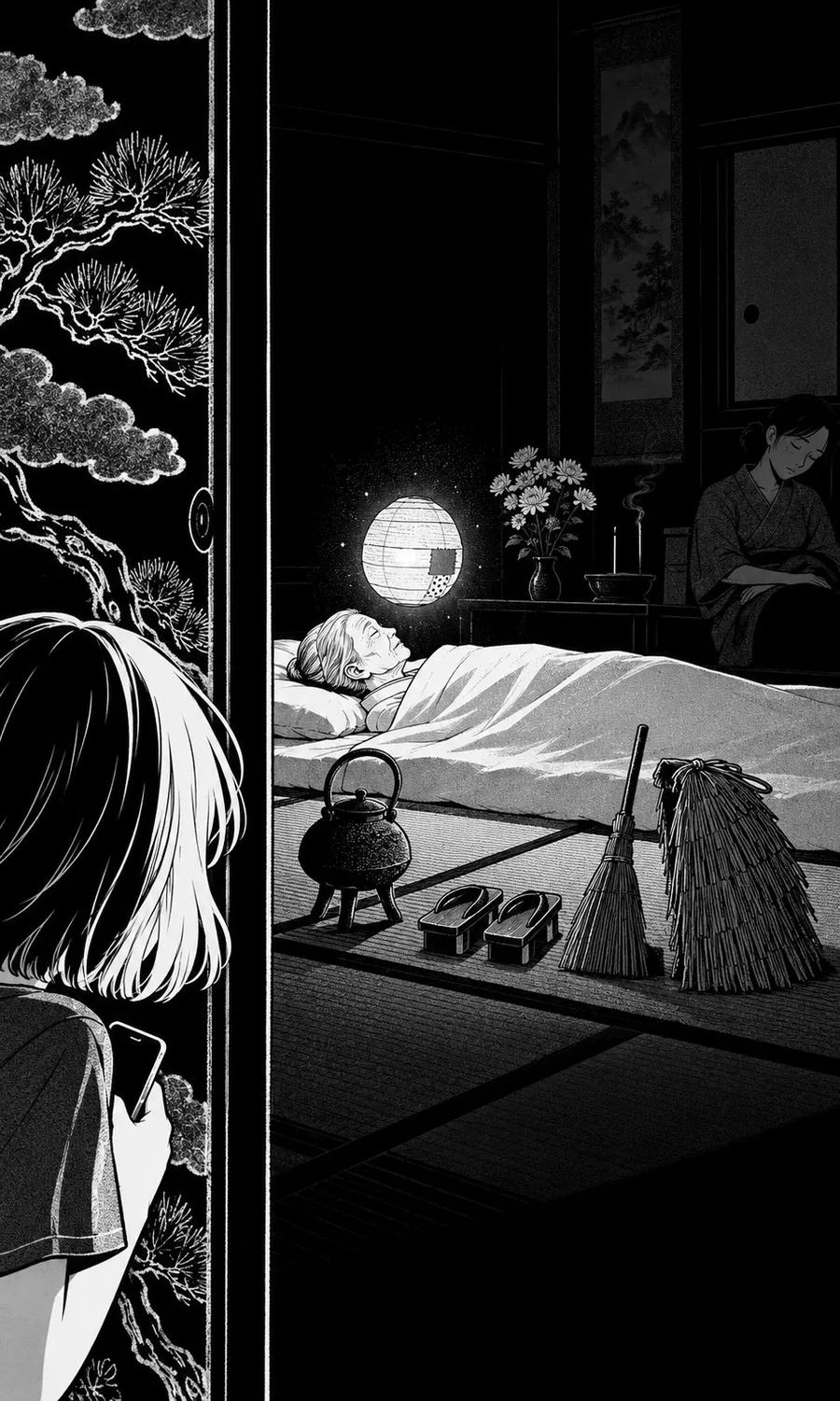
Behind the lantern, something climbed out of the well with a metallic scrape. A kettle made of dark iron, round and heavy, and it had legs. Three short, crooked legs. It let itself drop over the rim, landed with a clatter in the gravel, shook itself as if it were wet, and trotted off.
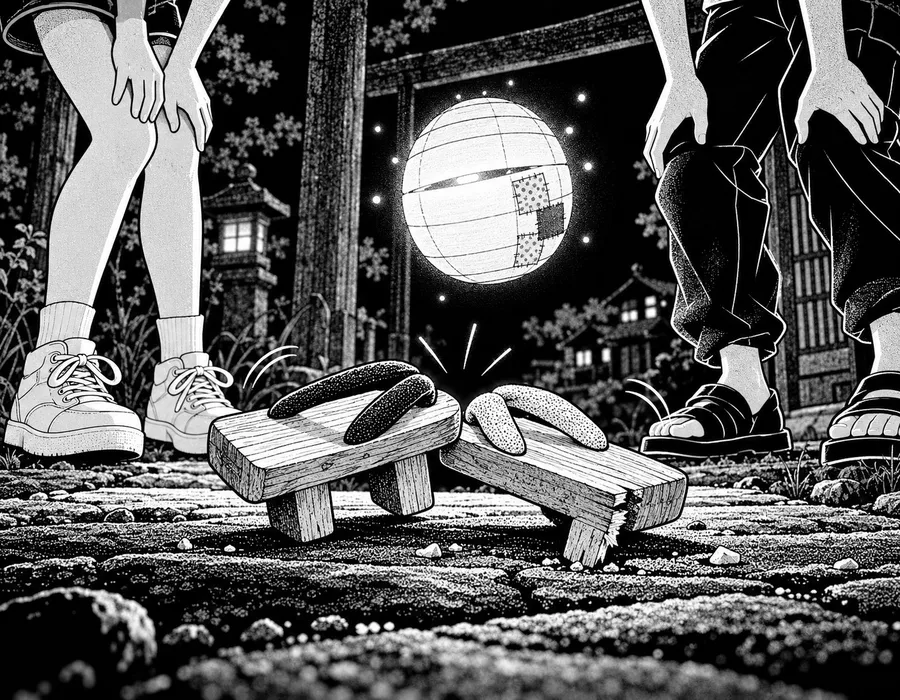
Then two wooden sandals. They leapt out of the opening at the same moment, like two frogs, and landed clattering on the gravel, karan, koron, one left, one right. Then a broom, which levered itself over the rim with its handle. Then a straw cloak, a big shaggy thing that looked like a haystack with shoulders.
They were coming towards the house.
Emi backed away from the gap until she bumped against the folding screen beside the table, a tall painted screen of several panels with pines and clouds on it. She crawled behind it. Through the gap between two panels she could see the veranda, the door and Grandma.
The clattering came up the steps.
The lantern appeared first. It floated in front of the fly screen, and the screen slid aside without anyone touching it. Its light fell into the room, across the tatami, across the flowers, across the white cloth. Then came the others. The kettle. The two sandals. The broom. The straw cloak, which had to stoop to fit through the door and rustled like a field in the wind as it did.
They lined up in a row at the edge of the tatami. None of them stepped into the room. Then they bowed to Grandma Sachi.
All at once. The kettle tilted its whole round body forward until its lid rattled. The broom bent its handle. The sandals tipped onto their toes. The straw cloak sank down until it lay almost flat on the floor.
The lantern did not bow. It hung above Grandma’s face, perfectly still, and its light grew dimmer, like a fire you shield with your hand.
Emi couldn’t think. A list ran through her head all by itself, like a song you can’t switch off. Dream: I’m awake, I can feel the mat under my knees. Tiredness: yes, but I can see every detail. Trick: Who? How? On what strings?
She saw no strings.
She made herself look closely. The kettle had a dent in its side, as if it had once been dropped. The left sandal had a red strap, the right one a faded, almost pink one. The right one stood a little crooked, as if one of its legs were shorter.
It was real. It was as real as the ash in the bowl and the white cloth.
And nobody would ever believe her.
Her phone was in the pocket of her pyjama bottoms. She could feel it against her leg, flat and hard. She thought of Dad. If you can’t prove it. She thought of Lina, who wouldn’t believe a word, of Mum, who was asleep, of Dad, who would wake up in a few hours and say she had been dreaming.
A photo. A single photo, and it would go on the left-hand side. For ever.
She drew the phone out very slowly and held it screen-down against her chest so the light wouldn’t give her away. Her fingers found the camera without looking. She had done it often enough.
The sandals had stood up again. The one with the crooked strap hopped a small step forward, right to the edge of the tatami, directly in front of the screen. There it stopped. Then it tapped its toe against the painted paper, just below the gap Emi was kneeling behind. Once. The way you knock on a door when you think someone is behind it.
It knew Emi was there.
Emi turned the phone round, held it to the gap and pressed.
The room went white.
She had forgotten the flash. It came on by itself when it was dark; she knew that, she just hadn’t thought of it. For a moment she saw everything at once, sharp and colourless as an X-ray: the kettle, the broom, the straw cloak, the lantern above Grandma’s face, and the sandal, which had just started a second jump and hung in mid-air.
Then it was dark again, and the sandal fell.
It fell the way a shoe falls. With a dry wooden clack onto the tatami, tipped onto its side and lay still.
“Don’t!”
The lantern had spun round. Its light flared up, glaring, almost white, and for the first time Emi saw that it had an eye. In the middle of the paper, where two patches didn’t quite meet, was a narrow slit, and behind it was light, and the light was looking at her.
Emi understood the word. She was sure it wasn’t German and it wasn’t English. She understood it anyway.
Then everything happened very fast. The kettle hissed like a kettle boiling over and ran. The broom swept itself backwards out of the door. The straw cloak tripped over the threshold and rolled down the steps like a bale of hay. Only the second sandal, the one with the red strap, didn’t run. It leapt over to the other one and nudged it, once, twice, with a small, desperate clatter, karan, karan, as if it were knocking on a door.
The other one didn’t move.
“Karan!” said the lantern. “Leave him. Come!”
The sandal didn’t want to. It nudged the other one again. Then the lantern sank down, slid underneath it and lifted it up, the way you pick up a child who won’t come along, and floated out with it. The sandal kicked in the air.
At the door the lantern turned round once more. The eye in the paper was narrow.
“Sachi would have warned you,” it said. “Now it’s too late.”
Then it was gone. Emi heard the scrape of iron on stone, the rustle of straw, a scraping as if the lid were being pushed back, and then the grinding of the big stone.
Then only the frogs down in the fields.
Emi sat behind the screen and couldn’t move.
Mum mumbled something in her sleep and turned her head the other way. Next door Dad breathed evenly, as if nothing had happened.
On the tatami, at the threshold, lay a wooden sandal.
Emi crawled over to it. Her knees were shaking, and when she reached out her hand, that shook too. The sandal was made of pale wood, worn at the heel, with two crosspieces under the sole and a faded, almost pink strap. It was light and cool. It was a shoe.
“Hello?” Emi whispered.
The shoe stayed a shoe.
Outside, gravel crunched.
Emi spun round. Someone was running across the courtyard, panting, in rubber flip-flops that slapped with every step. At the foot of the veranda steps he stopped. A boy. Thin, with short black hair and a T-shirt far too big for him with a faded dragon on it. Emi had seen him at the neighbours’ that afternoon when the first guests arrived. He had been carrying folding chairs and hadn’t looked at her.
Now he looked at her. Then at the sandal in her hand.
“What did you do?” he asked. In English, with an accent that made every word a little harder.
“Nothing,” said Emi, in English too. It came out too fast.
“I saw the lights. From my window. They came down the mountain, to Sachi’s house.” He climbed the steps and stopped at the threshold, just as the others had. “And then there was a white flash. What did you do?”
Emi held the phone out to him. She didn’t know why herself. Maybe because it was the only thing she had.
He didn’t take it. He looked at the screen, where the photo was still open, and his face went very still.
The photo showed the veranda. The threshold, the edge of the tatami, the open door, darkness beyond. And in the middle of the picture, a hand’s width above the floor, a wooden sandal. In the air. Slightly tilted, as if someone had thrown it.
Nothing else. No kettle, no broom, no lantern. They had all been outside the frame.
“You photographed it,” said the boy.
“I only wanted …”
“You photographed it, and now it’s dead.”
“It’s a shoe,” said Emi. Her voice sounded thin. “A shoe can’t be dead.”
The boy held out both hands, palms up. Emi gave him the sandal. He held it as if it were made of glass and ran his thumb over the pink strap.
“It was alive,” he said. “When things get very old, a hundred years, they get a soul. Tsukumogami. Everybody knows that.” He swallowed. “I saw them. When I was six. The lights. Nobody believed me.”
Emi would have liked to say that was nonsense. Things didn’t get souls; things were made of wood and iron and straw, and wood didn’t think. That was what she had learned.
But she had seen a kettle run.
“I believe you,” she said.
The boy looked up. He looked as if he had never heard that sentence before and didn’t know whether to trust it.
Then Emi smelled it. A faint, bitter smell, different from the sweet smoke. She turned round.
The incense stick was only a tiny glowing dot, just above the ash.
Emi rushed to the table. She grabbed the box and pulled out a new stick, so clumsily that two fell on the floor. Mum had shown her how: hold the new one to the old one until the tip glows. The glowing dot was so small. She held the tip to it and waited and prayed to nobody she believed in.
The tip glowed. A thin thread of smoke rose up.
She stuck it in the ash. Three minutes early.
When she turned round, the boy was still at the threshold. He had seen her rush. He didn’t say anything about it.
“My name’s Kai,” he said instead. “My grandpa is the priest at the shrine up there. Sachi gave me biscuits every Friday.”
“Emi.”
“I know.” He looked at the sandal in his hands. “She talked about you.”
Emi wanted to ask what Grandma had said. Instead she asked, “Where did they go?”
Kai nodded towards the courtyard, at the well. The lid lay neatly in place again. The stone on top. The straw rope, the white paper zigzags.
“Into the well,” he said. “You don’t touch it. My grandpa has said so for as long as I can remember.”
“Why?”
“Because you don’t.”
Emi’s eyes fell on the postcard, which had slipped out of her notebook and lay beside the cushion, picture side up. The courtyard. The well. And on the rim of the well, a yellow dot.
A lantern.
Kai picked up the card, and Emi realised he was thinking the same thing she was.
“Give it to me,” said Emi, meaning the sandal.
Kai hesitated. Then he gave it to her. “It doesn’t belong to you,” he said. “It doesn’t belong to anyone. It’s itself.”
“I’ll look after it.”
“You should have done that before.”
He went down the steps and across the courtyard without turning round. At the gate he stopped under the lamp.
“Don’t delete the photo,” he said. “It’s the only thing that proves it was there.”
Then he was gone.
Emi sat beside the table until morning and lit a new stick every thirty-four minutes. She didn’t miss one.
The sandal lay in her lap. Every now and then she put her hand on it and waited to see if anything moved. Nothing moved.
In between she looked at the photo. She zoomed in until it went grainy and searched for a thread, a hand at the edge of the picture, anything. She found nothing. And that was exactly why the photo was worthless. A sandal in the air proved nothing at all. Anyone could throw a sandal and press the shutter. If Lina had shown her a photo like that, Emi would have laughed.
She had the proof she had wanted, and it proved nothing. And to get it, she had done something she didn’t understand.
When it grew grey outside, she opened her notebook and wrote on the left-hand side:
2:08 a.m. Well lid opens from inside. Lantern (floats), kettle (walks), 2 sandals, broom, straw cloak. They bow to Grandma. One sandal knocks on the screen, in front of me. Photo with flash. The sandal falls and doesn’t move any more. The lantern speaks. Witnesses: me. Kai.
She read it twice. Then she added Dad’s question underneath. Proven?
Two witnesses. A photo. A sandal that no longer did anything.
She didn’t cross out the question mark. Underneath, very small, she wrote the question that hadn’t let go of her since the flash:
What have I done?
End of the sample. Find out what happens next in “The Mountain Above Tokyo”.